Friday, September 15, 2017

Adapting "Happily Ever After" Around The World

I mentioned the other day that fairy tales and folklore were perhaps the easiest place for those unfamiliar with translated literature to test the waters for the simple reason that they are recognizable to stories we are most likely already familiar with. Even within one language variations and adaptations of well-known tales are fairly common place. If we’re able to accept these variations within our own language it’s not too much of a leap to then go to variations in another language. The oral origins of fairy tales also add another layer as we can then compare variations of one central tale around the world and other cultures. That ability to learn about and compare that culture with our own through a commonly shared story is a definite benefit (though not the only or most important) of reading translated literature.

Without diving too deeply into the arguments about “original vs. re-telling vs. adaptation”, I’m going to come out and call the tales that I’ve included in this post adaptations. To me an adaptation blends the original tale with something innovative to produce a new and unique story. The core, the heart of the original tale is still there and recognizable, but it is a completely separate entity. If the original tale is the parent, adaptations are all their possible offspring; they share traits and features but they’re definitely not the same person.

The Flight of the Mermaid by Sirish Rao (Author), Gita Wolf (Author),
 Bhajju Shyam (Illustrator)


Let’s start with one that doesn’t stray too far from the original tale. Published in 2009 by Tara Books in India, The Flight of the Mermaid follows fairly closely to the Hans Christian Andersen version. Not Disney - no talking seagulls or domineering fathers here, trust me. In fact, this adaptation presents a much more modern and feminist ending where our mermaid friend doesn’t get the boy she’s been pining after but comes to realize that perhaps there is something even better for her yet to come. We’ll get back to that in a minute but first, I’d be remiss to not mention the other major reason I’m including this book – the art done by illustrator Bhajju Shyam.

A member of the Gond tribe in Central India, Shyam’s illustrations are based in Gond tribal art. It is so striking that I considered it another component, aside from the changes to the words of the story, that makes the tale an adaptation. You’ll hear me make this argument again later when we get to the Wordless books but I think that when considering picture books they are almost translated twice – once by a third party through the words of the story and then again by the reader when they view the illustrations. Not only is the text unique to the culture but in many cases so is the artwork. The good side to this as that the reader is exposed to the culture of origin, the bad is that it sometimes causes these books to be labeled as weird, odd or not something that American readers would enjoy because it’s not something we expect out of a picture book that originates here. (I mean, the above illustration is not what probably pops into your mind when you think "Little Mermaid," right?)  In the world of translated literature this is yet another hurdle a picture book has to leap before it is published here.


(Kristi’s side note: To be fair, like many of the books that I am including in my project from India, it was written and published in English. I am including this (and others) for a few reasons: 1) they were published in India FIRST and then in the United States 2) there are so many different cultures in India given the size of the population and books published from there can give us insight into many of them 3) as I said above, the artwork – I honestly considered doing an entire category on books that I felt the artwork was why they were published in the United States as the itself often paled in comparison and 4) it’s my project, see Disclaimer #1!)

Female empowerment seems to have become a common trope in modern fairy tales around the world. Not only does it rewrite Andersen’s The Little Mermaid in the story mentioned above, but French author Marjolaine Leray reimagined Little Red Riding Hood in her book Little Red Hood. 

Little Red Hood by Marjolaine Leray
(Translated by Sarah Ardizzone)

Gone is the demure damsel in distress that needs to be rescued by the woodsman, only to be replaced by a tiny savvy figure who takes justice into her own hands by poisoning her nemesis with a piece of candy. The book ends with a simple picture of the girl in her cape simply stating “fool,” which seems pretty spot on.


She never appears helpless or even afraid of the wolf, in fact you never see her eyes at all and most images of her are in profile and two-dimensional. The wolf, in contrast, towers over her with claws, teeth and bravado. None of this phases Red who questions the wolf’s personal hygiene (she tells him his breath smells!) to entice him to eat the poison laced candy. I also thought it was interesting that the artwork appears rough, almost quick sketches that only appear in black, white and red. 


Additionally, in what is perhaps a nod to the macabre nature of the story, all the text is hand-written in cursive, suggesting perhaps that it is better meant to be read by someone able to read cursive, with the wolf’s dialogue in black and Red’s in well, red. I did manage to actually get my hands on a copy of the original book and found this was true in the French AND English version.

 It is interesting to note the spelling of "juicy" here.  In my French copy it is "de la viande rouge et saignante!!!" which translates to "red and bloody meat" meaning it was the two time Marsh award winning French to English translator, Sarah Ardizzone's, choice to phrase it as above.  While I'm just pondering here, part of it could have to do with the way the english phrase fills the space on the page as it would have to work within the existing illustrations.  It could also be to give 'voice' to the Wolf's character.


The wildly popular Cinderella, (the original origins of which can be traced back to China though the most familiar version, thanks to Disney, is that of French author Charles Perrault who gave us the fairy godmother and glass slippers!) has also found itself the source of numerous adaptations that reimagine the demure heroine in a new light. One of my favorites was translated from Hebrew in 2010, The Girl With A Brave Heart, A Tale from Tehran.


by Rita Jahanforuz (author) and Vali Mintzi (Illustrator)

Written by “the Madonna of Israel,” Rita Jahanforuz, the story contains the familiar evil step-mother and step-sister who treat our heroine, Shiraz, as a servant. Without giving too much away (because you need to read this one!), the story changes when Shiraz is rewarded with beauty not for listening to spoken words but the unspoken desires of the heart, a lesson lost on her step-sister whose actions cause her to be mistaken by her own mother for a beggar. Without being preachy or didactic, the story ends with the reminder that people “do not always know how to ask for what they need.”

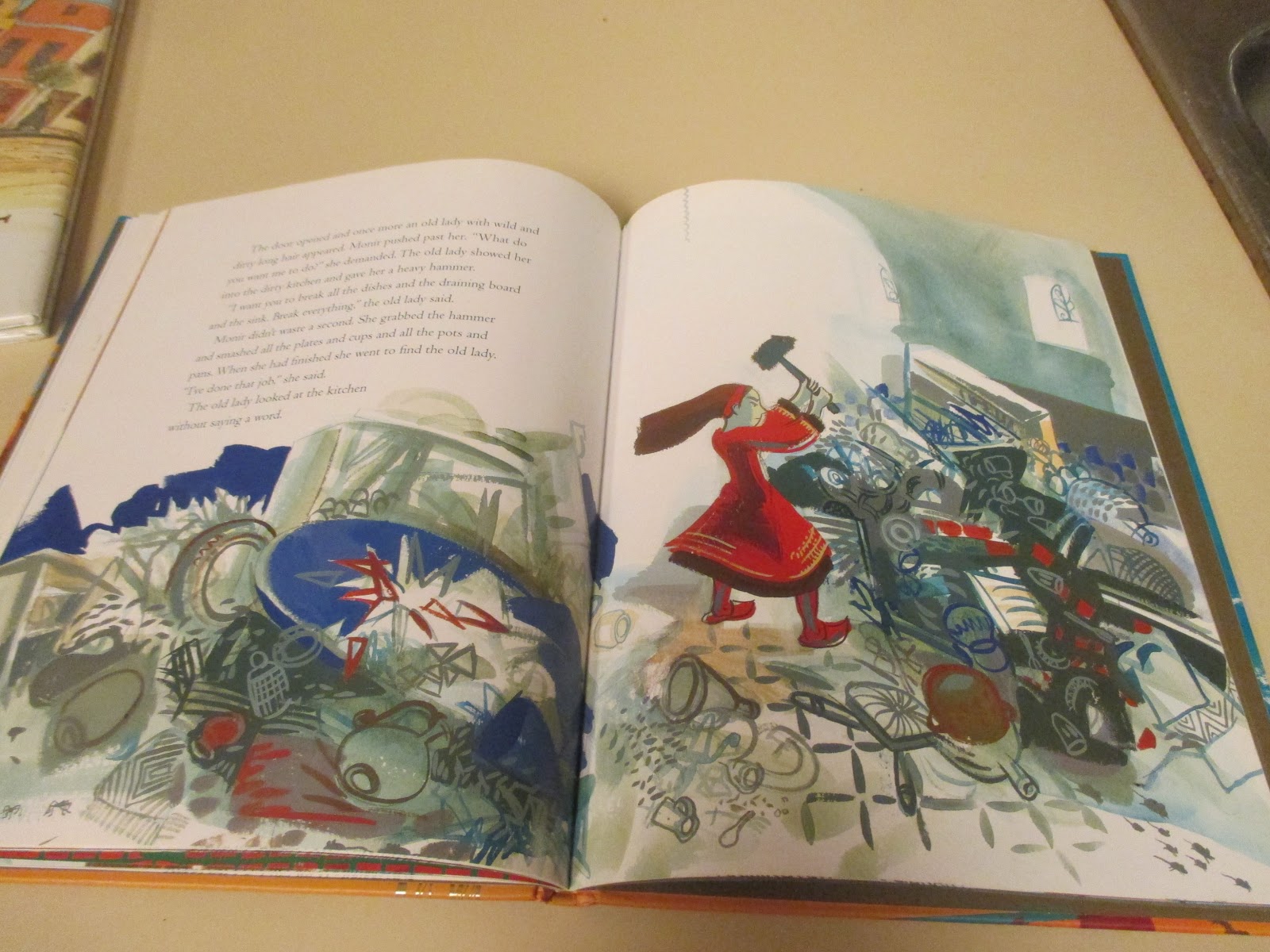

 The illustrations, done by Vali Mintzi are bright, bold and full of details that add to the text. In this adaptation the reader can see connections to the original tale but they are not as clear cut as the first two. In fact, on my first read through I immediately connected it to Cinderella in the first few pages but then noticed a marked evolution into a completely different tale which takes major detours from what we “know” as Cinderella. It made me wonder if perhaps Jahanforuz used some of the major plot points from the classic to connect readers to her version to share a new moral that contained a modern and needed message. One purpose of these first three adaptations very well may be to serve as commentary on the world they were written in and for. Interestingly, considering they were translated, it also then suggests that those stories serve a purpose globally as well.


(Kristi's note, while I was not able to determine the translator of the text, there is a note in the copyright information stating the book was "Originaly published in Hebrew by Kinneret Zmora-Bitan Publishing.")

One last book to share hails from Japan though this version was written in French and first published in France in 2013 and then in the U.S. in 2014.

Translated by Nicholas Grindell & Co.

The publisher describes Issun Boshi: The One Inch Boy as a classic Japanese fairy tale that “tells the story of Issun BĂ´shi, the tiny son of an old, long childless couple.” Sound familiar? On my first reading it definitely reminded me of Andersen’s Thumbelina or the English folktale Tom Thumb. Interestingly, the Japanese version of the folktale seems to predate both of those. What struck me most about this version from Icinori, the French illustrators Mayumi Otero and Ralphael Urwiller was that I would never in a million years guessed that it was published in 2014 when I pulled it off the shelf at the library.


It is slightly larger and narrower than your average picture book and the cover and pages are matte, devoid of the gloss and bright colors of many American style picture books, reminding me of an older version of a book that would have been published here. But opening it up, taking in the illustrations, it is evident the amount of effort and care put into this publication. While I will express slight concern about the authenticity of a French publication of a Japanese tale, I think the fact that it is noted that it is a story from Japanese folklore and contains accurate details in both the text and pictures when compared with other versions of Issun Boshi. I decided to include it in this post because of how strongly it resonates to the two tales I noted earlier, but we’ll definitely be circling back to Issun Boshi as an important character type in a post next week.

As we’ll continue to see in the next few posts, there are plenty of translated tales with fairy tale and folklore elements to choose from if you’re willing to look. If I could offer one word of caution it would be to do your homework before linking the book too closely to the language and culture it comes from. It’s important to always look for authenticity and accuracy and keep in mind that those things may not look like what you’re used to. In other words, don’t dismiss it just because it’s “different” before taking a look at why. These tales aren’t meant to be copies of the story you already know with cultural details stuck in for show – they are unique and deserve to be treated that way!

I’ll be back on Tuesday with some really neat books from Tanzania that created a brand new art form and a look at a pair of Japanese books that blend Western and Eastern art.

Tuesday, September 12, 2017

Once Upon A Time...

(The back of my desk, a reminder every time I walk into my office)

So begins some of the most well-known tales in literature.  Note that I said literature – not children’s literature.  The earliest written version of the classic fairy tales and folklore from around the world were never truly intended entirely for a younger audience.  But for these purposes let’s agree to set that entire debate aside as well as the argument surrounding the origins of this type of literature. I’m going to let the much smarter literary critics debate the poly-genesis vs. mono-genesis controversy and I’m also going to keep our focus to the earliest written versions of these stories.  There is no arguing the fact that they existed in many different forms well before Grimm, Andersen, Perrault and a myriad of others put them on paper, but another blog, another day… 

To that same end, as Dr. Gillian Lathey an expert in the field of translated texts for children, notes in her recent text Translating Children’s Literature, as a whole, children’s literature is often adapted, retold and abridged due to its “popular” nature.  This is especially true with fairy tales.  As she states “The free translation and alteration of popular children’s stories has led to a proliferation of versions.  Characters belonging to a children’s canon that is familiar across the world such as Cinderella, Pincocchio, Alice, the Moomins, Winnie-the-Pooh and the Little Prince, encourage the common perception that children’s literature is an international literature.” (113)In other words, the very nature of these stories lead them to be told, shared, adapted, re-told and then changed again.

Additionally, I did mention the other day how important it is to remember that the majority of these tales were passed orally long before they were ever actually written down.  Further, once they were written down, they went through many different variations even by the same author.  The Grimm brothers were notorious for this as can be seen in this side by side comparison of the 1812 and 1857 versions of Hansel and Gretel.  While I could spend a great deal of time postulating the “why” behind this, it’s probably safer to concede this to another blog, another day as well.  And that’s to say nothing about the changes that have been made to the stories since then - you can find many different translations of a single tale that vary greatly.  Take the Grimm’s Aschenputtel (Cinderella) for example – some translations completely remove the step-sisters mutilation of their feet or the doves pecking out their eyes on grounds that it is too gruesome for young readers.  This means that not only are many readers not even aware they are reading a translation in the first place, but, as Lathey points out “nor are most readers aware of the degree to which translators, let alone retellers and adapters, have altered the German source texts of the Brothers Grimm, merged different versions of the same tale, or drawn on exiting translations.” (115)  So those “simple little fairy tales” we know and love, perhaps not so simple.

(Kristi’s full disclosure: I love fairy tales and folklore.  I planned an entire semester at school and home around the ability to take a class on the topic.  I did a major project on Raisel’s Riddle as a Jewish adaptation of Perrault’s Cinderella.  My favorite author, Adam Gidwitz, penned the this year’s Newberry Honor winner The Inquisitor’s Tale (which swaps spots with Charlotte’s Web as my favorite book) but it was his Grimm trilogy that knocked my socks off.  My nine year old son and I still giggle every time we think about how Gidwitz translates Aschenputtel.  Fairy tales rule.)

Fairy tales, folklore and myths seem like an obvious place to begin to look at translated tales for a few major reasons.  First and foremost, it’s important to remember that nearly all the favorite classic tales are in and of themselves translations to our English-speaking selves.  In fact, Andersen and the Grimms both find themselves among the top 10 authors translated into English.  Oddly enough though, these are not the versions most Americans are familiar with thanks in large part to Disney’s adaptations of the classics.  If your “once upon a time” ends in “happily ever after” it’s fairly safe to assume that you’re not reading the earliest recorded versions of many of these tales.  No, those tales are much more likely to be filled with murder, cannibalism, anti-Semitism and child abuse – perfect bedtime stories, right?

Even so, nearly every culture has their own variations of the most well-known of these stories.  If one of the main “purposes” of translation is to expose the reader to other cultures and perspectives, what better way to do so than through a fairy tale or folklore that shares common elements with a story they are probably already familiar with?  Granted, this is a very simplistic interpretation and is by no means the only (or in my opinion most important) reason for translation.  But for publishers worried about the “strange and unfamiliar” aspects of foreign literature scaring away potential readers, fairy tales seem like a much safer road given that familiarity.  This is probably the reason that a large chunk of the literature translated for children often tends to fall in this category.

When I first started to organize my categories, the following was what I came up with for what we’ll be discussing over the next few posts:

Folklore, myths, fairy tales – they are the building blocks of cultures, language and literature worldwide.  And without diving too deeply into the debate of whether they evolved under polygenesis or monogenesis, there is no denying that similar stories (for example a creation story) are part of nearly every culture that ever existed.  Further, those stories very often share similar characteristics that allow for a basis of comparison.  The similarities allow the connection to be seen and the differences allow us to learn about the culture they come from.  These types of stories are a rich source of material when it comes to translated texts because there is a desire to learn about other cultures through the stories that are woven into the fabric of who they are – they connect us.  We come across these stories all the time without every even realizing we’re being exposed to a translated tale (thank you Disney!).  For this category I strayed from those most common tales into picture books that combine pictorial elements of their culture with the story.

A few things to keep in mind with the material from this category; just like there is debate over where these types of stories started, there is much debate surrounding the original (written) authors of some of the literary versions.  I have tried to give credit where credit is due in comparing some texts, but in some cases have used the most well-known version as a base for comparison.  Secondly, I know there are HUNDREDS of tales that could potentially fall into this category.  I have tried to pick ones that are important for both the story and the art given the fact that I am focusing on picture books.  If you know of other versions, please comment!   As I said, if you’re looking to begin to dabble in translated literature, this is an easy starting point.  If fact, you may have already been doing so without even realizing it.  Hopefully my suggestions as well as others may spark an interest to go beyond those most widely known versions.  Thirdly, I love Disney as much as the next child born in the eighties who can sing every word to The Little Mermaid, Beauty and the Beast, Aladdin, and The Lion King (and now Frozen thanks to the next generation that lives under my roof) but these are NOT the original tales and should not be considered as such.   Yes, most are based on some of the early written stories, but they have been greatly changed and “sweetened” up to make them “more palatable” for children. 

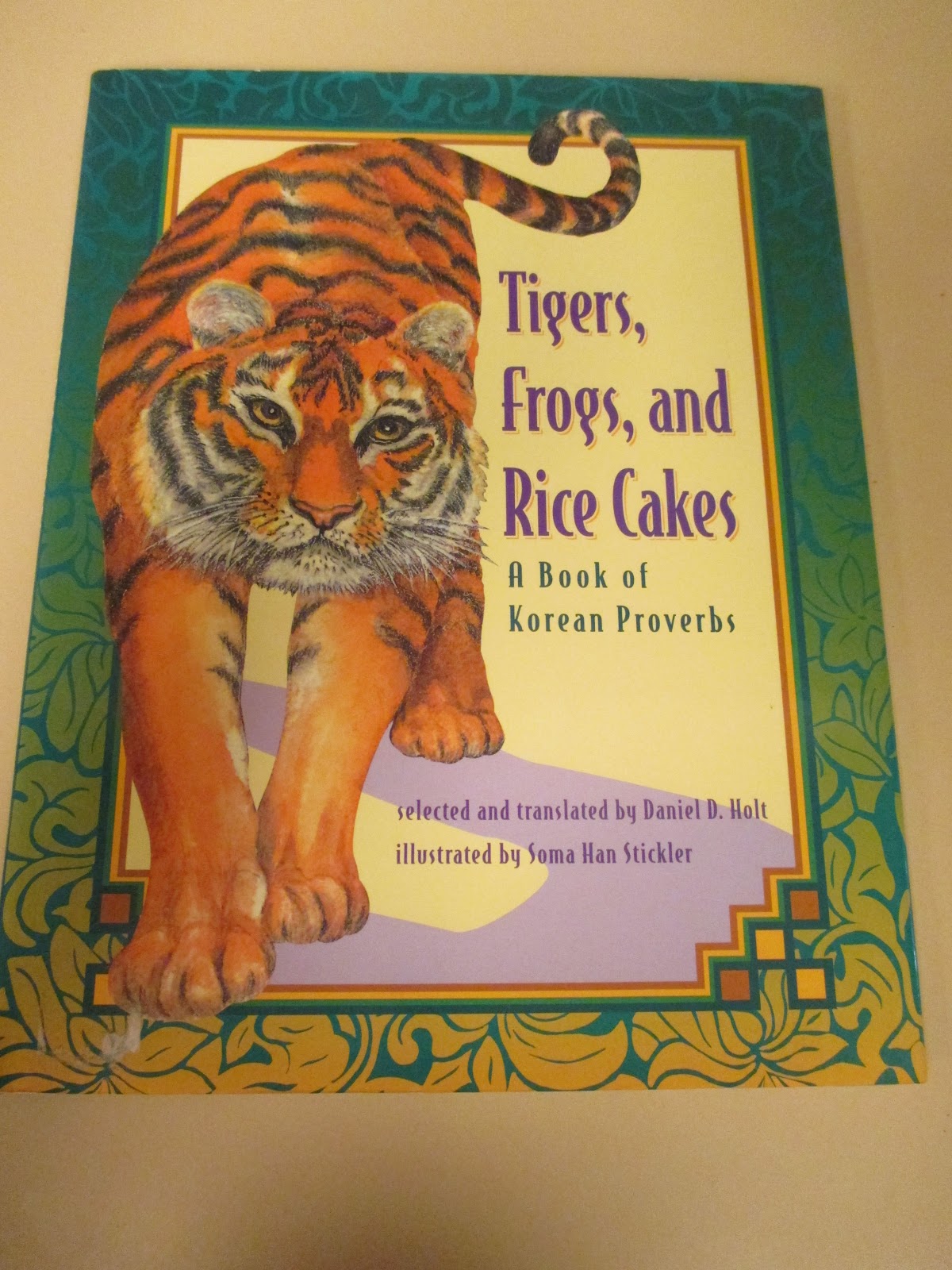
A late edition to this post, but consider it a sneak peak at some of the wonders to come.  I was at the Kerrytown Book Fest this Sunday and snagged a couple beautiful books for my collection.  Even though I already have my books set for this category, I found one that I knew I had to share.

Selected and Translated by: Daniel D. Holt
Illustrated by Soma Han Stickler

I haven't had a lot of time with it, but I knew I couldn't pass up the opportunity to share it even in a limited capacity.  There is a wonderful explaination from the translator about the usage of proverbs in Korean society and he notes "by comparing proverbs across cultures, we can identify some of the similarties and differences that help us appreciate the diversity that characterizes the world."

 Note the text is bi-lingual, appearing in English and Korean


Also, the back of the book lists all of the proverbs and an explanation as to their meaning.  There is an additional note from the publisher that credits Song Que Hahn for assistance as to the translation and meaning.  The illustrator was also born and lived in Korea until she moved to California in the mid 70's.  It's important to note how all of these items together add authenticity and accuracy to the work.


In the next couple of posts I’ll be taking a closer look at adaptations of some of the most well-known fairy tales, a closer look at the importance of art that is associated with the place or culture the book originated in and some fairy tale and folklore characters from around the world that we may not be familiar with but fill roles (such as the hero or the trickster) that is a commonality in many of this tale type.  Again, I look forward to other suggestions and comments others may chime in with!
 

And fairy tales still rule!

Friday, September 8, 2017

Breaking It Down

I have read a lot of books for this little project of mine.  A LOT of books.  Once I figured out how to find and then get my hands on some of the translated titles I was coming across it seemed with a little bit of digging and legwork there was no shortage of translated picture books out there.  My local library had some.  Eastern’s library had a bunch.  And I became the bane of my library when I discovered how many books I could get my hands on via MELCAT, the state wide library lending program in Michigan.  In just a few months I’d collected nearly three hundred books to read, review, ponder and analyze.

So then what?  I had to figure out a way to make sense of it and be able to share the best (and maybe not the best) of what I’d found.  After picking out my “must share” books, I began to see some patterns emerging and realized if I came up with some very broad categories I could cover a lot of different types of books and ideas.  This would also give me the ability to share more books in a shorter period of time.

Over the next few months, I’ll be discussing books based on seven different categories I’ve come up with.  In order of how I plan to present them, the categories and a description of them in my own words follows.

Folktales, Myths, Fairy Tales
Folklore, myths, fairy tales – they are the building blocks of cultures, language and literature worldwide.  And without diving too deeply into the debate of whether they evolved under polygenesis or monogenesis, there is no denying that similar stories (for example a creation story) are part of nearly every culture that ever existed.  Further, those stories very often share similar characteristics that allow for a basis of comparison.  The similarities allow the connection to be seen and the differences allow us to learn about the culture they come from.  These types of stories are a rich source of material when it comes to translated texts because there is a desire to learn about other cultures through the stories that are woven into the fabric of who they are – they connect us.  We come across these stories all the time without every even realizing we’re being exposed to a translated tale (thank you Disney!).  For this category I strayed from those most common version of tales into picture books that combine pictorial elements of their culture with the story.

“The Hits”
While the translated market only makes up a very small percentage of the United States’ publishing market (and the picture book genre only a fraction of that) there are some translated books that have been incredibly successful.  What is even more interesting to consider is if the average reader (and parent) even realizes that some of these are translated books.  From personal experience, I can’t begin to recall how many story times I attended that featured Press Here during which I have no idea the book hailed from France.  I also have multiple teacher friends that included The Rainbow Fish in many lesson plans who were shocked when I told them the story was written by Swiss author Marcus Pfister.  Both these books have been translated into numerous languages and produced follow-up titles.  The question then becomes, why these?  And one step further, if these do so well (and setting aside the argument if it’s good or bad that people aren’t even realizing they’re translated) why not others?

Similar to single titles that have made a splash in the US publishing market are series that were created in one country, reached massive popularity there and then have been translated into many different languages and distributed worldwide.  Some of the series that I looked at dated back almost fifty years and were translated into English well after publication in their country of origin – why?  And further, what do some of these books have that lead to their popularity?  Is there an "it" factor that guarantees success?
 
Controversy
When I came up with the “controversy” category in it were books that I felt contained what are often labeled “adult” topics which are seen as not appropriate for children or their literature. Considering picture books are geared at the “8 and under” crowd (not taking into account longer more detailed graphic novels which I decided not to consider as part of this project because of their length and complexity), those published in the United States don’t often take on such topics as death, politics, war, loneliness, abandonment, gender and marriage controversy (to name just a few) in such a blatant and bold way.  The translated books in this category, though, do not apply ‘kid gloves’ when approaching such topics.  When looking at these books I hoped to then determine why these titles were translated and how they are received in the United States.  Is there a lack of similar material (even though it’s wanted) which has caused books like these to be translated?  How are the received in the US?  More than one of the titles I have included have found themselves on the “banned” list due to content, did they face similar criticism in their country of origin?

Outside the Box
There was no end to the creativity I found in the books that I examined, but I felt that some deserved a category all their own for being “outside the box” of what you normally expect to find in picture books.  These were the books that I came across that I wanted to share with others simply because they were different, the fact that they were translated and came from around the world was just a bonus!  This category is my answer to the critics of translated literature saying that it is “weird” or that there’s really nothing special about it that we don’t already have here.   The uniqueness of these books is what earned them a spot in this category. 

Wordless
While it may seem like an odd choice, after reading so many books I felt very strongly about including the “Wordless” category.  The more books I read, the more I realized just how different this project was because it specifically analyzes picture books.  Pictures are an entire language of their own!  I have developed an entirely new respect for the complexity of picture books through this project.  While the words themselves they contain are translated from one language to another, the pictures remain the same but the way they are “read” by an audience does translate them in my opinion.  Subtle details, colors, lines and choice of perspective view can be translated differently by a reader of the original book (called the source) as how they are viewed by someone from a different place and culture.  When pictures speak a thousand words what language are in they in?

Lost in Translation
I wanted to fall in love with every translated book I read, I honestly did.  But there were some that well, left me scratching my head a bit.  A few left me frustrated trying to figure out why this particular story was ever what a publisher chose to use as an example of translated literature.  It was those stories that I felt are most often held up as examples of why we don’t have more translated literature  - because it’s not up to American standards or quality, or that it’s just weird.  (And yes, a few of these were just weird)  Some of them I found a disconnect between the pictures and the story, something just didn’t match up.  (As a side note, this isn’t unique to translated picture books, on a regular basis an author of the story has little or no contact or interaction with the person tasked with illustrating the book.)  A few of them may have been appropriate at the time and location they were first published but not be the best for a modern audience who fails to realize the initial intended audience.  A few may simply be a cultural disconnect – something that was acceptable and understandable where it originated but does not “read” the same here.  I want to clearly state that I don’t think any of these books are “bad” I just think that something was lost or is missing from their original publication to their translated form.  And one step further, there's nothing wrong with that, in fact there can be something appealing in the dissonance these texts may create.

Kristi’s Favorites
Have you ever read a book, closed the back cover and had this mixed up sense of sadness because it was over, joy because you’d found something that spoke to you for some reason (with a twist of confusion sometimes for the inability to pinpoint exactly what it was), frustration that it’s taken you to this point in your life to find the book in the first place and eagerness to share your discovery with everyone and anyone you can find?  That’s what these books were for me.  Some made me laugh, some made me think, a few touched my heart with their message and a number of them amazed me with their creativity and effort.  The other thing that they all had in common was my sadness that it took me doing this project to even find them in the first place!  But true to form that didn’t keep me down for long and I quickly realized the opportunity I now had to share these titles with others. 

I realize these are very broad and general categories and many of the books that I'll mention could easily fit in more than one category.  And I'm honestly not a huge fan of categories in the first place, especially in literature as I think they can be somewhat limiting.  But when faced with this much material, it seemed like the most clearcut way to be able to present it.  I am in no way trying to limit any of these titles to just these categories or into the specific category I've placed it.  

I will be doing an introductory post on each topic and then two to four additional posts that could be considered ways of categorizing my categories.  While I can’t possibly cover all the books I’ve read, each category contains at least twelve books that I found important enough to share for some specific reason.  Again, as I mentioned in my last post, I would love to hear from you if you know a title that might fit in any of my categories.  Or if you’d like additional suggestions that didn’t quite make it to my blog but I still loved, I’m happy to share more ideas!

I’m planning on posting blogs on Tuesdays and Fridays, but if that changes I will be sure to mention it before it happens.  Just like my last post, not all will be this lengthy.  Additionally, will try to include links to books, authors and other relevant data.  As I mentioned, if you want to find these books, I promise they’re out there!  My own home library is now overflowing as I own copies of every book that I’m planning on discussing, but I originally found I could borrow almost every title through a library in my state if I could be patient enough for it to make its way to me.  You can also check out local bookstores, amazon and I had lots of luck through used books sellers online. The best way to make an impression on the publishing industry that we need more translated books is through our dollars.

I’ll be back here Tuesday to kick off our “Once Upon A Time” translated adventure!

Tuesday, September 5, 2017

Prologue

Once upon a time…

That’s the way all great stories start, right?  Well, perhaps not all of them, but if Chaucer and Dickens used it and it serves as the introduction for tellings of countless fairy tales, I’d say it carries a tad bit of weight in the literary world.  I can’t pretend that any of my ramblings could hold a candle to any of those classic tales, but I’m going to borrow it anyway!  So….

Once upon a time, (last February), a few weeks into the winter semester of classes at Eastern Michigan University, I was surfing through TED talks after I’d watched a particularly fascinating one earlier that day in my multicultural children’s lit class by novelist Chimamanda Adichie on “The Danger of a Single Story” I wasn’t all that familiar with TED talks before but an hour later my head was swimming with all the possibilities.  I was almost ready to call it a night when I happened to stumble across a talk by Ann Morgan called “My Year of Reading A Book From Every Country in the World.”

I was floored.  My own bookshelf was very similar to the one she described and I had never thought about how potentially damaging that could be.  My multicultural class was already opening my eyes to how sheltered or uninformed I was about certain aspects of life in the United States and I couldn’t even begin to imagine how much I was missing or ignorant to on the world stage.  It wouldn’t solve every problem, but surely expanding my literary palate to include more global titles would be a start!
That video started me on a great new adventure.  I’m serious, I was so excited that I posted it on my facebook status then and there, stating that I was going to undertake the challenge, but do so with my own twist – by looking at the world of children’s literature in translation.

People that know me weren’t really surprised by my overly ambitious statement.  This is not the first time that I’ve been struck by something on a whim and hit the ground running; a few years ago my family celebrated the National Food Day every day for a year, which I cooked and blogged about.  The following year we did a project on all 50 states that included getting mail from all the states, eating regional cuisine while we studied it and learning about the people, landscape, products and cultures.  That was followed by the birth of my super villain Anita Direction who planned to steal each of those fifty states and could only be stopped by the two detectives living at my house who received clues from her and her henchman every day.  Like I said, I am no stranger to big projects and I never do anything half-way.


So after my bold proclamation I started to do a little digging and realized with my family, classes, my part-time job, clubs, other commitments, etc, I may have bitten off a little more than I could chew in the space of a year.  Especially considering I wasn’t sure how I was going to be able to get my hands on children’s books from every country in the world.  Flustered but not defeated I pitched the idea to one of my professors as a potential independent study.  My gratitude to her for getting onboard nearly as quickly as I had, her patience with my overambitious nature, her ability to rein me in when I get too far ahead or a bit overwhelmed and her encouragement that this little project just could be a launching point for a much bigger task (like my Master’s thesis) knows no bounds.  She helped me get the project approved by “the powers that be” and then together we figured out how to make it manageable, interesting, informative and fun.  It’s evolved a bit from my original idea, but I think it’s stayed true to my purpose to learn more about the world.  And I’m hoping that maybe It will inspire just one person to pick up just one of the titles I blog about and add it to their own library. 

Before we get too far along in all of this, though, I think that it’s important that I offer a few “disclaimers” about this little project of mine…

Disclaimer #1:
I am not an expert.  I repeat, I am not an expert.  I am an undergrad student who is studying and learning about Children’s Literature.  Take what’s written here with that in mind.  I’m doing my best; researching, learning, digging, questioning and then putting all the pieces back together, but I’m bound to make a mistake (or quite a few of them) along the way.  With that in mind I have no problem relying on the experts.  I have an amazingly talented, patient, encouraging, hardworking, inspiring professor overseeing my little adventure.    I have turned to numerous members of the Eastern Michigan faculty for advice and input.  I have dug through scholarly articles, textbooks and research from people with a wealth of knowledge on this specific topic.  I’ve had the opportunity to speak with translators and publishers to get their insight.   Those are the experts.  Notice once again that my name is not included in that category, no expert here.  When all else fails, see Disclaimer #1.

Disclaimer #2:
I don’t speak or read any languages besides English.  I have a smattering of Spanish after three years of studying it way back in high school and I know tidbits of French (right, Mom?) but I am not fluent in any language besides English.  And honestly, I sometimes even question that.  While that may seem to put me at a slight disadvantage, let me point out that while the process of how and what gets translated fascinates me, the actual act is far beyond my capacity (See Disclaimer #1). I, just like every other reader of translated literature, depend on the person doing the translation to use their knowledge and skills to deliver me the same story in the language I am able to understand.  That is one monumental task which as we’ll see doesn’t always go so smoothly for a variety of reasons.  So everything that I’m basing my information and opinions on is from the published English translation, not the original text the way it was first published in its country of origin.

Disclaimer #3:
I am an adult.  I know this seems like a pretty obvious one, but let me clarify.  The world in which “Children’s Literature” exists is mixed up and discombobulated.  Adults write material intended for children and then adults choose what materials to make available for children.   We adults have good intentions, but they sometimes go astray by needing to label, categorize and even censor materials for younger readers.  In my opinion (see Disclaimer #1) far too often we don’t give kids the credit they deserve.  Personally, I often find their wisdom and insight surpasses those that are much older.  Some of the best literature I have ever read was “meant” for someone a quarter of my age at the time I was reading it.  When I pick up a book I do not automatically dismiss it as being “for kids” nor do I try to read it with the mindset of its apparently intended audience.  I just read it as me in that moment.  I will admit that sometimes it’s hard to chuck the adult (and especially now the parent) blinders, especially as I’m scrutinizing some of these picture books. 

Disclaimer #4
This is a big project.  Ever since it started worming its way around my brain more than six months ago I have known it was going to be a huge undertaking.  To that end, I can’t possibly cover it all.  I have had to pick and choose, narrowing my focus and rein myself in more than once.  (Those that know me personally are now nodding vigorously in complete agreement, knowing that this is usually the way things go with me and my projects.)  To this point I have read, reviewed and researched well over three hundred picture books but I know that I can’t possibly cover all of that in a semester long project, let alone all the amazing books still out there!  I have provided some links for other areas to check out if you’re interested, and I’m always interested to hear from others who have a great title or article to share! 

Disclaimer #5
In no way, shape or form am I dismissing any of the amazing titles being published here in the U.S.  And while I see the difficulties of the publishing industry getting on board with translated materials, I know first-hand the struggle for talented authors right here to have their own materials published.  I am an aspiring author myself, and a proud member of The Society Of Children’s Book Writers and Illustrators (SCWBI) who has been rejected a fair share of times myself and watched as friends with talents far surpassing my own also struggle to get their foot in the door.  There are incredibly creative authors writing inspired literature for kids right here in the United States for sure.  What I’m suggesting is that the United States isn’t the only place that is happening.  And one step further, by reading not only domestic authors but global ones as well, we are giving ourselves (and our children) a much more well-rounded, enriched view of the world we live in.  Take that for what you will after reminding yourself of Disclaimer #1 of course.

Disclaimer #6:
We all like different things, have different opinions, view the world differently – and that’s OK!  In fact, that’s fabulous!  You’re probably not going to like every book I mention and I’m sure you won’t agree with everything I have to say – GREAT!  That is just one of the things that makes literature (and the rest of the arts) so special.  There is no black or white, no right or wrong – we all have the ability to interpret, decide, analyze, like, loathe and love for ourselves.  Feel free to speak up – agree, disagree, add your opinion to the conversation!  Even if I WAS an expert I wouldn’t be an expert in what every person that happens to read this little blog thinks and feels.  We all get to do that for ourselves – own it!

Alright, I think that about covers the big ones.  I’m sure if something else comes up along the way I’ll be sure to point it out.  Besides, when all else fails I’m going with #1!

One more thing before I forget, while this project is academically based, this blog and my musings in it are much more informal and the language and tone I intend to use will reflect that.  So put those dictionaries away, you won’t need them here!  know this was a fairly lengthy post, I promise they won’t all be so extensive. On Friday I’ll be back with some information on how I decided to categorize the books for my project and how and when I intend to publish this blog over the next few months.  

Tuesday, August 29, 2017

One Week

One week!

Back in my sorority days (Alpha Chi shout out!) we'd say "get excited" but I think I'm past that stage.  After much anticipation, reading, researching, writing, worrying, reading some more, falling down rabbit holes of things that I find interesting that probably should be shelved for "another blog, another day," some more worrying, a ton more research, a dash more worry and a metric ton of nervous excitement, we're t-minus one week until launch.

If you haven't taken the opportunity to follow along or perhaps share this blog with your 100 closest friends I highly suggest you do that here soon.

I'll have my first official post up next Tuesday (also the day my children (finally) go back to school!) and I promise it'll be worth checking out for at least a laugh or two.

I'll see you (and all those friends of yours, right??) back here Tuesday!

Sunday, July 9, 2017

Coming Soon!

"Translating The World One Picture Book At A Time" will be up and running soon!  Check back for more information on translated children's literature, great (and some not so great) examples of phenomenal picture books from across the globe and WHY it's so important to teach our kids to read globablly!